Raul

Raul’s Blog

Raul D. Hernandez is the founder and CEO of Forever Redwood. An expert on restoration forestry, he writes about the practical dimensions of ecoforestry, based on his hands-on experience restoring ancient forestland in Northern California since 1995. He also answers customer questions about Forever Redwood furniture, the sale of which helps fund the restoration work.

Archive for the ‘Global Warming’ Category

Report: Old-Growth Forests Dying Off

Thursday, January 29th, 2009

A recent article in the news reports on a U.S. Geological Survey finding that old-growth forests in the west are dying off, due to global warming.

THURSDAY, Jan. 22 (HealthDay News) — Trees in old-growth forests in the Western United States are dying at twice the rate they were a few decades ago, and experts suspect regional warming is to blame.

The report, led by the U.S. Geological Survey (USGS), found that the increase in tree deaths has included trees in a variety of forests, elevations and sizes. Species have included pine, fir, hemlock and other coniferous trees. In addition, the rate of new tree growth has not changed, according to the report in the Jan. 23 issue of Science. [Read the full article.]

The article goes on to report that the consequences of this phenomenon include ”increased wildfire activity across the Western U.S., as well as bark beetle outbreaks that are occurring at unprecedented levels across Western North America.” And we learn that “these changes in climate necessitate a reevaluation of policies on how forests are managed, including new ways of dealing with wildfires and limiting development.”

From my perspective working to restore Old-Growth Redwood forestland in northern California, here’s my take. Global warming is real. But so is a mindset in certain parts of the scientific/political/academic community to use alarmist tactics to push conservation and other agendas. Yes, higher temperatures have created problems with die-offs in many western forests that are affecting Old-Growth Forests as well. There are huge bug infestation increases and other issues. Some of it can be attributed to climate, but I assure you, the bulk of the issue is poor forest management practices that are coming home to roost.  Also, the article makes it seem that ALL western forests are facing this grave issue. This is the alarmist part. The truth is the bulk of the lumber volume west of the Mississippi is on the Western Coast. The die-offs that were studied are inland from the coastal areas. Although the inland forests amount to several times the acreage of the coastal forests from Washington State down to Central California, they represent less overall timber volume than the coastal forests do. Therefore the coastal forest health is more important and it is not addressed in this article because it doesn’t fit the alarmist agenda.

I don’t disagree with the alarmist agenda. We need to scare the pants off people to fix these things, but it’s also good to keep your perspective. The major forests of the west (the coastal forests) are not being affected much if any by what is discussed in this article. On the western coast, in the Redwoods where Old-Growth Again operates, climate change is tempered by the ocean’s influence over the coastal climate.

We desperately need to make changes in the ways forests are managed. And, this is mentioned in the article. Unfortunately what is considered change is in most cases a drastic swing in the opposite direction away from over harvesting and poor soil management to almost complete preservation (no tree harvesting or almost none). Preservation is fine if the forests are in good shape. But, imposed on structurally deteriorated stands, it creates even more problems than it solves (species composition, tree quality, fire hazard, etc.).

If old trees are allowed to dominate the canopies of forests while the poor quality and overrepresented species are slowly culled, the forest will once again recreate microclimates that will insulate themselves and begin to positively influence the external climate to its advantage. But, the forests of the west are fragmented and full of problems created mostly by bad forestry. I am certain that under the present management schemes, the forests in general will continue to deteriorate including the old-growth tree patches that remain. But, if the forest is managed to recreate mature and old-growth trees, and most of the poor quality trees are systematically removed, the opposite of what this study predicts will happen. I assure you.  I will prove it to you.  Just check back in 30 years and you’ll see how much healthier and larger the lands your crazy uncle manages are in.

Forest Management and Fires

Friday, October 17th, 2008

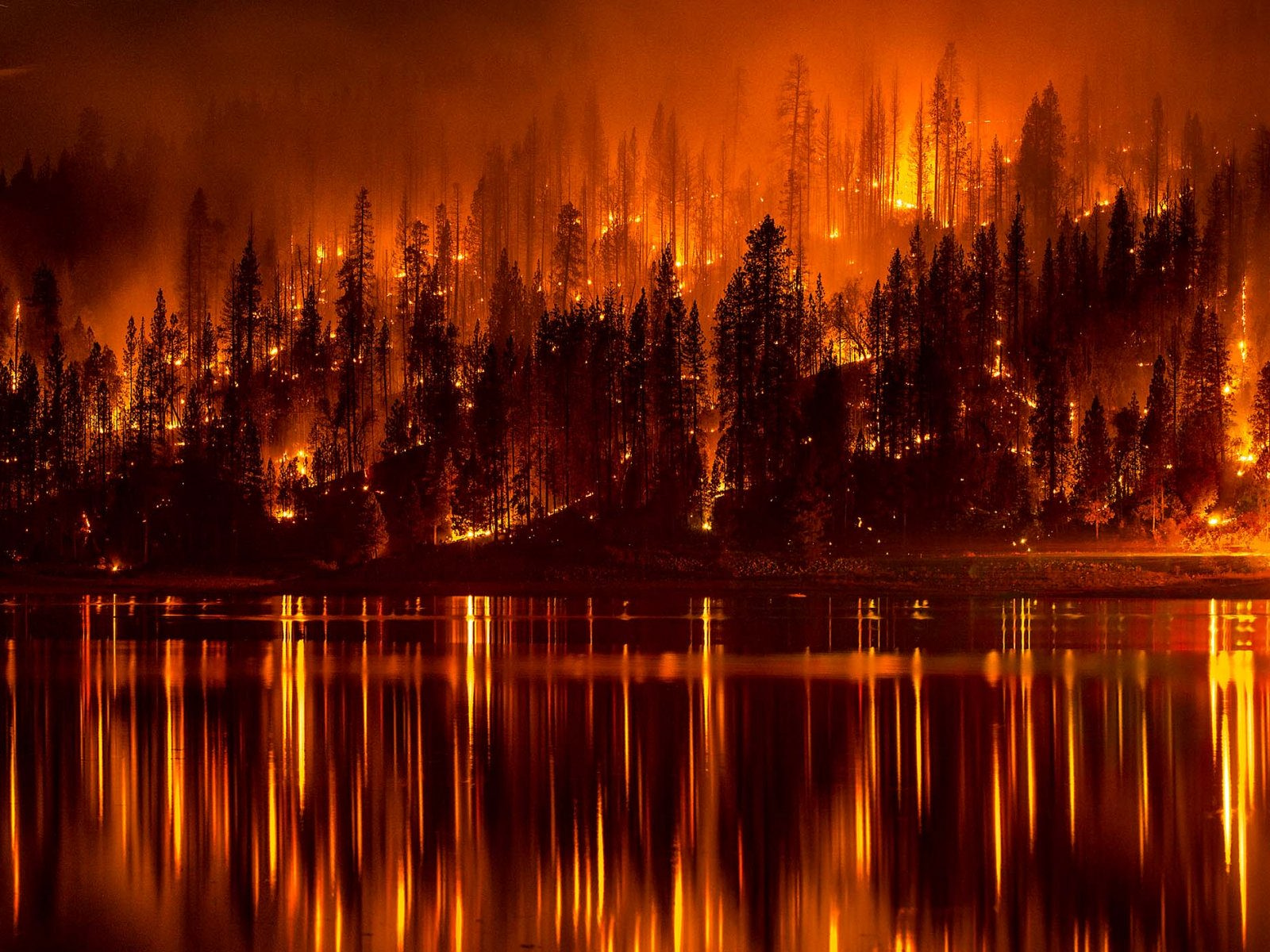
Each summer and fall the fire season explodes and the news is filled with stories of burning homes and thousands of brave men and women fighting fires and risking their lives protecting communities. It’s a giant annual event and its getting worse. In July 2008, lightning storms ignited thousands of fires in California that burned for weeks. The losses and cost to contain them were staggering. The real calamity in all this is that it is mostly an avoidable disaster. It really doesn’t have to be this way.

Forest fires are a vital and natural part of all western forests. The fires regenerate and balance countless biological processes. For example, some vegetation has been recorded as extinct in areas where fires were suppressed only to reappear after a fire!

The probability an average fire will grow to be a catastrophic fire is multiplied when forestlands are poorly managed. Most of the forests of the west today are young and overgrown. Hot, highly destructive fires feed on the excessive lower limbs, downed woody debris and the suppressed and dying trees of mostly young forests.

A labor-intensive program of thinning suppressed trees and lower limbs of standing trees combined with lopping and scattering the excessive woody debris lowers this dangerous fuel level.  Lower fuel levels limit the opportunities for a normal fire to become a devouring dragon.

Thinning is central to the Restoration forestry we’ve been practicing since 1995. Thinning mimics many beneficial effects of mild fires and is a proven proactive solution to the growing fire catastrophies we have in the western United States. As our work grows over the years, we hope to make a significant contribution to fire hazard reduction in our neck of the woods.

To learn more about thinning, fire hazard reduction and basic restoration forestry practices that are applicable to forests anywhere, please visit our forest restoration page at: http://www.oldgrowthagain.com/sustainable.php

Global Cooling Forest Management

Monday, October 13th, 2008

Everyone is green these days. Even the giant oil companies are flooding the airwaves with green marketing campaigns. It sounds promising, and many positive things seem to be taking shape in response to the climate challenge. But, if you look closely, much of it is less than it seems.

For example, forestry is at the center of the climate change equation. Forests sequester enormous amounts of carbon. The larger the trees are in a forest, the more carbon is held per acre.

Since the early 1990’s, a fast-growing “Sustainable Forestry” worldwide movement has been making positive inroads. A handful of organizations now “certify” many millions of acres of forestland as “sustainably harvested”. Standards vary, but, certification requires overall improvements in forestry practices away from the old “industrial models”. Sustainable forestry is helping many forests around the world reverse degradation and in some cases rehabilitate deteriorated stands to a limited degree.

Unfortunately, if you study the numbers, it’s clear even the most stringent sustainable forestry standards will have only a modest impact in the climate change equation. Climate cooling carbon sequestration numbers are easy to calculate for any parcel of forestland. For example, in California’s Redwood forest, several large forestland owners are certified sustainable. These sustainably harvested forests are harvested at approximately 20% of the standing timber volume per decade. An average quality young stand of Redwoods adds about 30 to 35% per decade in net new wood volume. As it ages, this rate of growth slows. If cut at 20% per decade, the young stand will add a modest amount of net volume for a few decades and then level out. The forest will then be maintained as a healthy and robust stand of trees of average size with few if any large or old trees.

If, on the other hand, the rate of cut is limited to 10% in any one decade, the forest will retain more than 3 times the wood volume per acre over the coming century than if “sustainably harvested” at 20% per decade. Forestland managed at this more conservative rate will grow ancient trees again over time and make a large contribution to global cooling. This is the central tenet in “Restoration Forestry”.

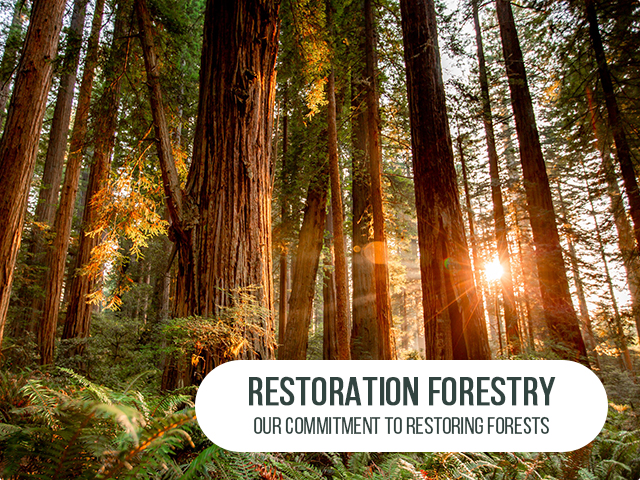
We are Old-Growth Again Restoration Forestry. Our mission is to fully restore the volume and productivity of our forestlands and bring back the big trees. Parklands are lovely and necessary, but we can’t turn all the forests of the world into parklands because the cost would be exorbitant. Restoration forestry allows you to cut conservatively while also bringing back the large ancient trees. In our 14th year, our forests are a testament to what can be accomplished. Your furniture purchases through the years fund the hard work. 

To read more about our forestry practices, please go to: 

http://www.oldgrowthagain.org/sustainable.php

Save Money

Exclusive Coupons, News
& Discounts by Email Only

 
First   Name: 
Email*

Select Subscription:

: Newsletter
: Discounts & Special Offers

We respect your privacy.

Inside the U.S.(Toll-Free):
866-332-2403

Outside U.S.:
01-707-495-4955

Email us or Start Live Chat

Order Online
Prefer a catalog?

Order a print copy or download for free

Shop with Confidence
+